- Every thrift store has two types of shoppers — and the difference between them is not luck or experience
- The items worth real money are almost never displayed prominently — they are hidden in plain sight
- Seven specific habits separate profitable resellers from casual shoppers
- A single tool has made the most important habit — knowing what something is worth — take 3 seconds instead of 30 minutes
- After reading this, you will never look at a thrift store shelf the same way again
Picture two people walking into the same Goodwill on the same Monday morning. They walk the same aisles, look at the same shelves, pick up some of the same items. One of them walks out with a bag full of things that will sell for $400 this week. The other walks out empty handed, thinking "there was nothing good in there today."
Same store. Same shelves. Same items. Completely different results.
This is not a story about luck. It is not a story about experience or special knowledge that takes years to build. It is a story about a handful of specific habits — the way profitable resellers actually think and move through a store — that most people have simply never been taught.
This article is going to teach them to you right now.

"The items worth real money are almost never sitting on top with a spotlight on them. They are hiding in plain sight, waiting for someone who knows how to look."
— Flip n ProfitThe Two Types of Thrift Store Shoppers
Before we get into the habits, let's understand who these two people actually are — because recognizing which one you currently are is the first step to becoming the other.
Sees What's There
- Looks at display value and condition only
- Moves quickly through aisles
- Skips bins and bottom shelves
- Judges by appearance first
- Guesses at prices from memory
- Leaves thinking "nothing good today"
Sees What It's Worth
- Looks at brand, material, and maker marks
- Checks every bin and bottom shelf
- Ignores condition until value is confirmed
- Checks prices with data, not memory
- Buys based on demand score, not gut
- Leaves with items others walked past
The smart reseller is not smarter as a person. They just have a different framework for moving through a store — and once you see it, you cannot unsee it.
The 7 Secrets That Change Everything
They Never Judge by Appearance First
A casual shopper sees a tarnished, scratched ring and puts it back. A reseller picks it up and looks for a hallmark. A scratched 14K gold ring is still worth $80. A perfect-looking gold-plated ring is worth $2. Appearance is irrelevant until you know what something actually is. Material, brand, and maker always come before condition in the evaluation order.
They Check Every Bin, Not Just Every Shelf
The most valuable items in any thrift store are disproportionately likely to be in bins, baskets, and boxes — not neatly displayed on shelves. Why? Because staff put effort into displaying things they recognize as having value. Everything they don't recognize goes in a bin. A Kenner Star Wars figure, a Griswold cast iron pan, a first-edition hardcover — all likely in the unsorted bin. Always go through the bins completely.
They Read the Bottom of Everything
Flip over every piece of pottery, every dish, every cast iron pan, every piece of jewelry. The bottom is where manufacturer marks, hallmarks, country of origin stamps, and pottery signatures live. A "Made in Germany" mark on the bottom of a vase can mean the difference between $3 and $300. Most shoppers never flip anything over. This is one of the most valuable habits in all of thrift store reselling.
They Know What Day and Time to Show Up
Monday and Tuesday mornings between 10am and noon — right after the weekend donation surge hits the floor — is when the best inventory is freshest and least picked over. Resellers who show up on Saturday afternoon are competing with everyone who showed up Monday through Friday. Timing is not a small advantage — it's often the entire difference between finding something and missing it by hours.
They Snap First, Decide Second
This is the habit that Flip n Profit was built specifically to support. Before a smart reseller decides whether to buy anything — before they even look at the price tag — they snap a photo. The demand score tells them whether the item is worth pursuing. The price tells them the margin. Snap first removes all emotion from the buying decision. You stop buying things that look cool but won't sell, and you start buying things that will actually make you money.
What Happens When You Snap Any Item
Open Flip n Profit on your phone at app.flipnprofit.com — no download, no signup required. Point your camera at any item in the store. Take the photo. In about 3 seconds you see:
Fair market value — what real buyers are actually paying right now, not what the thrift store thinks it's worth. Demand score — HIGH, MEDIUM, or LOW — telling you how quickly this item will actually sell once you list it. A complete listing description — already written, ready to copy and paste the moment you get home.
The woman in the photo at the top of this article? She's doing exactly this. She found a vintage camera. She has no idea if it's worth $8 or $800. She snaps it. Three seconds later she knows.
Try a Free Scan Right Now — No Sign Up →They Never Skip "Boring" Sections
Kitchenware. Books. Linens. Sporting goods. Most casual shoppers walk straight past these sections. Smart resellers know these "boring" sections hide some of the most consistent profits in the store. A vintage Pyrex casserole dish in a pattern collectors want sells for $60-$120. A first edition paperback in the wrong place on the book shelf sells for $40. A vintage cast iron skillet sells for $150. None of these look exciting from a distance. All of them are worth stopping for.
They Walk In Knowing What They're Looking For
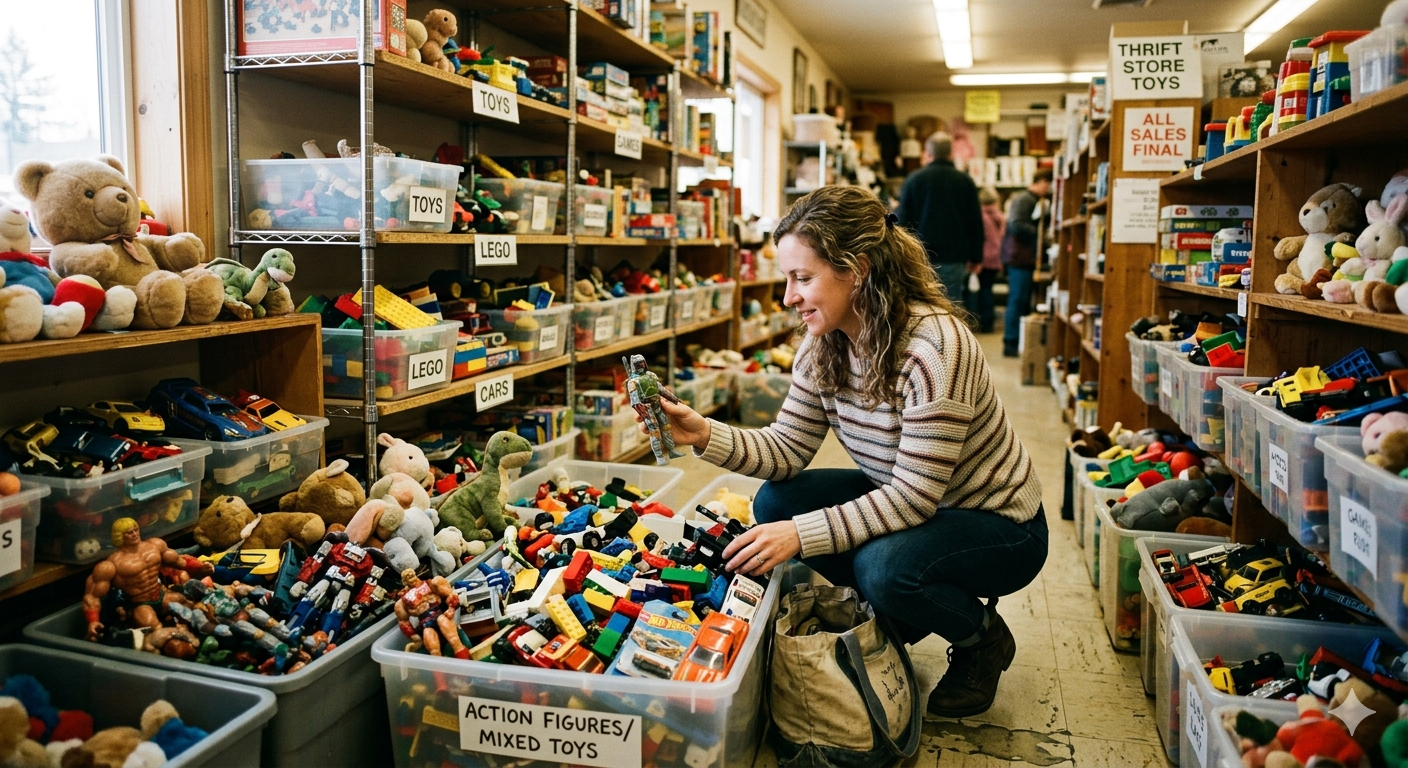
The woman in the photo above is not randomly hoping to find something good. She walked into that toy section knowing exactly which items have strong collector demand right now — Star Wars Kenner figures, Hot Wheels redlines, He-Man, Lego Castle sets. Profitable resellers have a mental list of 10-15 categories they always check for. Over time this list gets built by experience — and it can be fast-tracked massively by reading articles like this one and using demand data from tools like Flip n Profit to understand what is actually selling.
Putting All 7 Together — What One Trip Looks Like
Here is what a trip through a thrift store looks like when you apply all seven habits together — versus the way most people do it.
The average casual shopper walks in, goes to whatever section interests them, looks at displayed items, decides nothing looks good, and leaves in 20 minutes having bought nothing or buying something cheap without knowing its real value.
The profitable reseller arrives Monday morning, goes straight to fresh restock areas, works every section systematically including bins and bottom shelves, flips over everything interesting, snaps anything with a brand name or unusual marking in Flip n Profit before touching the price tag, and leaves an hour later with 3-8 items they know will sell. Every buy is confirmed by data, not gut feeling.
Your Action Plan — This Weekend
- Open Flip n Profit free at app.flipnprofit.com on your phone — no download needed
- Go to your nearest thrift store on a Monday or Tuesday morning between 10am and noon
- Work every section — including kitchenware, books, toys, and bins — not just the ones that look interesting from the aisle
- Flip over everything interesting and look for marks, signatures, hallmarks, and brand names
- Snap anything with a recognizable brand BEFORE looking at the price tag
- Only buy items with HIGH demand scores that give you a strong profit margin
- List everything that same evening using the description Flip n Profit already wrote for you
That vintage camera in the first photo? The reseller who snapped it discovered it was worth $145. The $8.99 price tag on it was a 16x return on her investment. That information was in her hands in 3 seconds.
The toy bin in the second photo? She found a loose Star Wars figure worth $42 buried under generic toys priced at $1 each. She knew immediately because she had snapped it before anyone else picked up the same bin.
Same stores. Same items. Completely different results — because of how they looked, not where they looked.
See What You've Been Walking Past.
Open Flip n Profit free right now and snap the next item you pick up. No signup, no download. Just a photo and 3 seconds.
Try a Free Scan Now →